


The Morning After a Central Florida Storm

The useful work the morning after a storm is not cutting. It is seeing what is on the house, what is in the driveway, and what is still hung up in the crown. A chainsaw on a limb that is holding tension, or on a limb still tied to a power line, is how people get hurt before a crew arrives.
Trees for the Fallen is based in Osteen. After a storm that hits Volusia and Seminole at the same time, we open the house and the blocked driveway first. A routine prune waits. That is true in Deltona, DeBary, Orange City, DeLand, Sanford, Oviedo, and Winter Springs.
Walk the property once, then stop
Stay off a roof. Do not pull a limb that is still attached to a standing tree if the trunk is cracked. Do not drag brush across a pool cage to make the yard look better. A torn screen is cheaper than a torn cage frame, but it is still a repair you did not need to cause.
A tree on the house or through a roof jumps the line.
A tree across the only driveway jumps the line if you cannot get a car out.
A hanging limb over a sidewalk, a play set, or the place you have to walk is next.
Brush in the yard, with the tree still standing and sound, can wait.
A limb on a power line is the utility's line until they clear it. Stay back.
What the photos need to show
Send three photos and one sentence. The sentence is whether anyone is in the house and whether the driveway is blocked. The photos are the whole tree, the damage, and the way in.
From Deltona and DeBary the common storm tree is a pine that was already leaning, or a laurel oak that let go of a large limb. A wet week before the wind is part of the story. Say if the lean is new. A photo of the lean from the street and one of the base tells us if this is a same-day hazard or a scheduled removal.
In Sanford and DeLand the storm wood is often a live oak limb on a porch or a tin roof, not the whole tree. If the trunk is standing and the limb is the failure, we may be reducing, not removing. Do not have someone top the oak while they are already up there.
In Oviedo the damage we get called for is a limb on a screen cage or a paver drive. Leave the cage alone. Do not walk brush across it. In Winter Springs, Tuscawilla and the oak lots around it drop long laurel limbs. Same rule: photo the crown, do not strip it.
What we haul, and what waits
On a scheduled removal we haul the same day. After a county-wide storm we clear the house, the drive, and the hangers first. Brush piles that are not blocking anything may be the second trip. That is the honest order. A crew that promises every yard in the county a full cleanup on day one is guessing.
If the tree is in the planting strip or the right-of-way, it may be the city's tree. We will say so before we cut it. That shows up on the older streets in Orange City, DeLand, and Sanford more than on a newer subdivision lot.
Price after a storm is still the same math
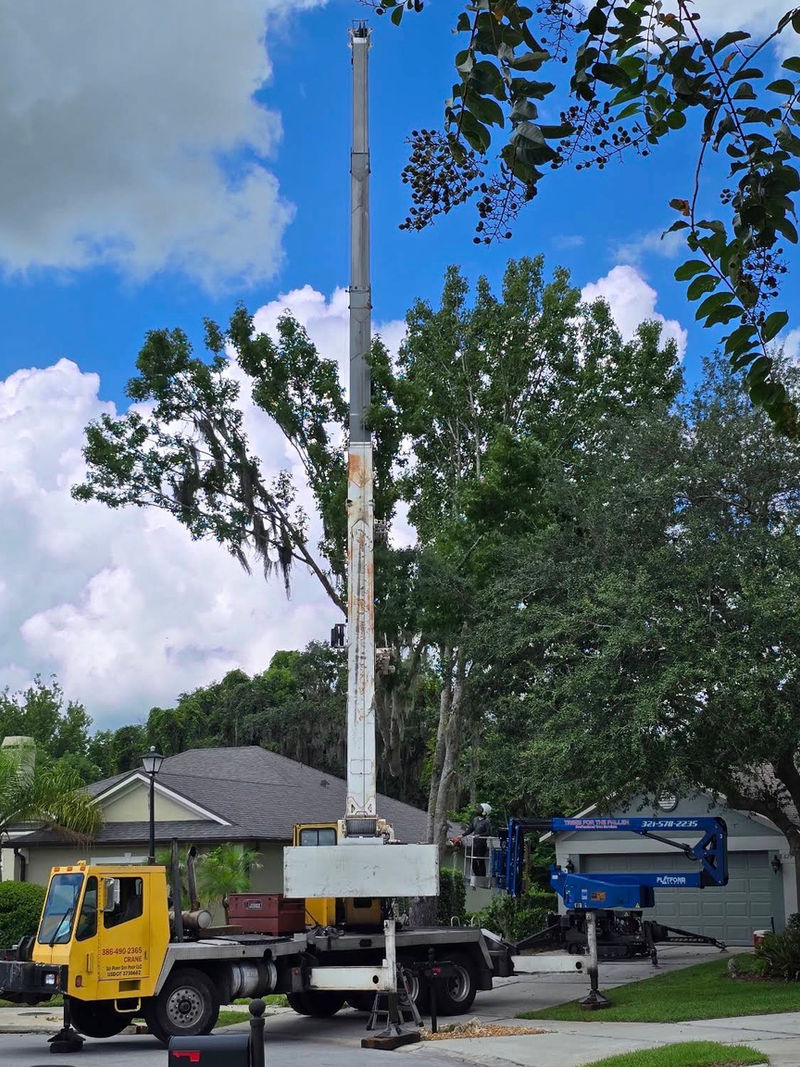
A tree we can drop into an open yard is the lower end. Most removals with a real crown run $900 to $2,500. A tree hung over a roof, with no drop zone, is the crane or the rigging job, and that is the work that reaches $4,500 to $5,500. Storm day does not change the physics of the lot. It changes whose job we do first.
Call (321) 578-2235 if a tree is on the house. Use the quote form for a limb in the yard and a standing tree. City details are on the Deltona, DeBary, Orange City, DeLand, Sanford, Oviedo, and Winter Springs pages.
Comments