


What an HOA Tree Letter Usually Means

An HOA letter about a tree is usually a clearance problem or a dead limb, written in language that sounds like an emergency. The useful question is what the letter actually asks you to do. Clear the roof, the fence, or the sidewalk, and the job is often a prune. Call the tree hazardous, or demand it come out, and it may be a removal. Those are different prices, and the letter is the document that decides which conversation you are in.
Send the letter. A photo of the tree without the letter makes us guess what the board wrote. We would rather read the sentence than have you summarize it.
The three sentences we see most
Limbs over the roof, the neighbor's yard, or the sidewalk. That is a clearance prune or a reduction if the tree is sound.
Dead limbs, or a dead section of the crown. That is deadwood removal. It is not a reason to top the tree.
The tree is hazardous, diseased, or must be removed. Send that page. We still look at the trunk before we agree. Boards are not arborists, and some letters use hazard for a limb that is only over a roof.
We do not top live oaks or laurel oaks to make a letter go away. Topping cuts the limb back to a stub. The sprouts that follow are weaker than the limb you were worried about, and they grow back into the same roof. A reduction takes the weight off and leaves a branch that can hold. If the letter demands a flat top, we will say no and quote the cut that actually satisfies a clearance rule.
Where these letters come from
In Lake Mary, Heathrow and Timacuan generate a lot of them. The trees are large, the lawns are finished, and the rule is usually about clearance and a clean crown, not about taking the oak down. A prune for that letter is usually less than a removal. Photos of the letter, the whole tree, and the access are enough to tell which one.
In Oviedo the letter is often about a limb over a cage or a neighbor's screen. The fix is the limb, and the cage stays protected. Do not let a trim turn into brush dragged across the pavers.
In Winter Springs, Tuscawilla and the surrounding oak lots get letters about laurel oaks that have gotten long. We take the deadwood and the weight. We do not strip the inside of the tree. A routine prune there is usually the same week. A tree already on the house is the same-day call.
In Longwood and parts of Casselberry, the letter sometimes points at a tree that is not yours. A trunk in the planting strip, or a limb that is only over the sidewalk, is often the city's tree. We stop and tell you before we cut it, so you can get the approval instead of paying to remove something you do not own.
What to send with the letter
The letter, including the page that says trim or remove.
A photo of the whole tree from the street.
A photo of the limb the letter is about.
A photo of the access: driveway, side gate, or street only.
The deadline, if they gave you one.
If the deadline is a few days and the tree is not on the house, say so. We can often schedule the prune inside a normal week. We cannot honestly promise every HOA in the county a same-day visit during a storm week. Hazards go first.
How this hits the price
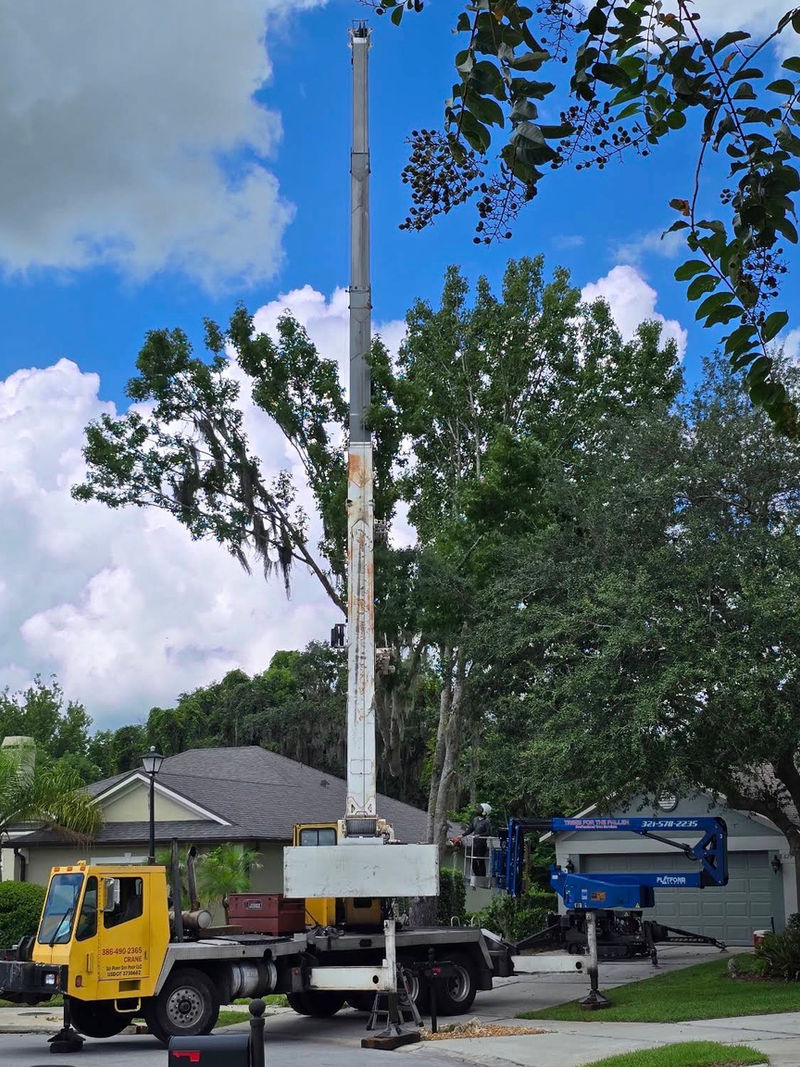
A clearance prune is the smaller ticket. A removal of a multi-limb oak, when we can work from the drive, is commonly $900 to $2,500. If the only way out is over the roof or the cage, the crane day is the $4,500 to $5,500 range. The letter does not change that. The lot does.
Call (321) 578-2235 or send the letter through the quote form. More on the neighborhoods is on the Lake Mary, Oviedo, Winter Springs, Longwood, and Casselberry pages.
Comments