


When a Live Oak Should Be Reduced, Not Removed

A live oak that drops a limb on a roof is not automatically a removal. On a lot in Sanford, DeLand, or Longwood, the tree often predates the house. If the trunk is sound and the complaint is clearance, weight, or one dead limb, a reduction keeps the tree and fixes the problem.
Removal is the right call when the trunk is hollow at the base, the tree is split, or it is already leaning at the house with no place to leave it. Those are different jobs. Mixing them up is how people pay for a crane day they did not need, or how they top a tree and get a worse crown back in two years.
What a reduction actually is
A reduction takes weight off the long limbs. We cut back to a lateral branch that can take the load, clear the roof and the gutter line, and leave a tree. The canopy gets smaller. It does not get flat-topped.
Topping is the cut we will not make. A topping cut chops the limb in the middle and leaves a stub. The next growth is a cluster of weak sprouts attached to decay. On a live oak over a tin roof or a porch, those sprouts become the next failure. A reduction costs less than living with that cycle, and less than taking the tree down when the tree was still sound.
Look at the trunk before you look at the roof
Stand at the street and look at the base, then look at the roof. The photos that matter are the whole tree, the limb that is the problem, and the base.
A solid trunk with one limb on the shingles is usually a reduction.
Deadwood in the outer crown, with green wood inside, is a prune.
A cavity you can put a hand into at the flare, or mushrooms at the base, is a removal conversation.
A crack that runs from a fork down the trunk is not a trim.
A tree in the planting strip or over the sidewalk may belong to the city. We stop before that cut.
Historic lots make this more common, not less. Downtown Sanford and the older streets in DeLand and Longwood were built under oaks. The fence, the porch, and the power drop came later. Clearing the roof does not require taking the oak if the trunk is holding.
Where the lot changes the answer
In Lake Mary, the same oak is often an HOA letter about clearance, not a hazard. Heathrow and Timacuan lawns do not need a removal scar if a reduction satisfies the letter. Send the letter with the photos.
In Casselberry the limit is often the side gate, not the tree. A reduction can be done from the driveway or the street side. A boom lift often cannot fit a standard side gate. Say that in the first message so we do not price a machine that cannot stand.
On a Sanford lot along Lake Monroe, river wind is the other reason people call. Raising the canopy and taking the long river-side limb is a reduction. Skinning the inside of the oak is not.
What it costs, in the ranges we actually see
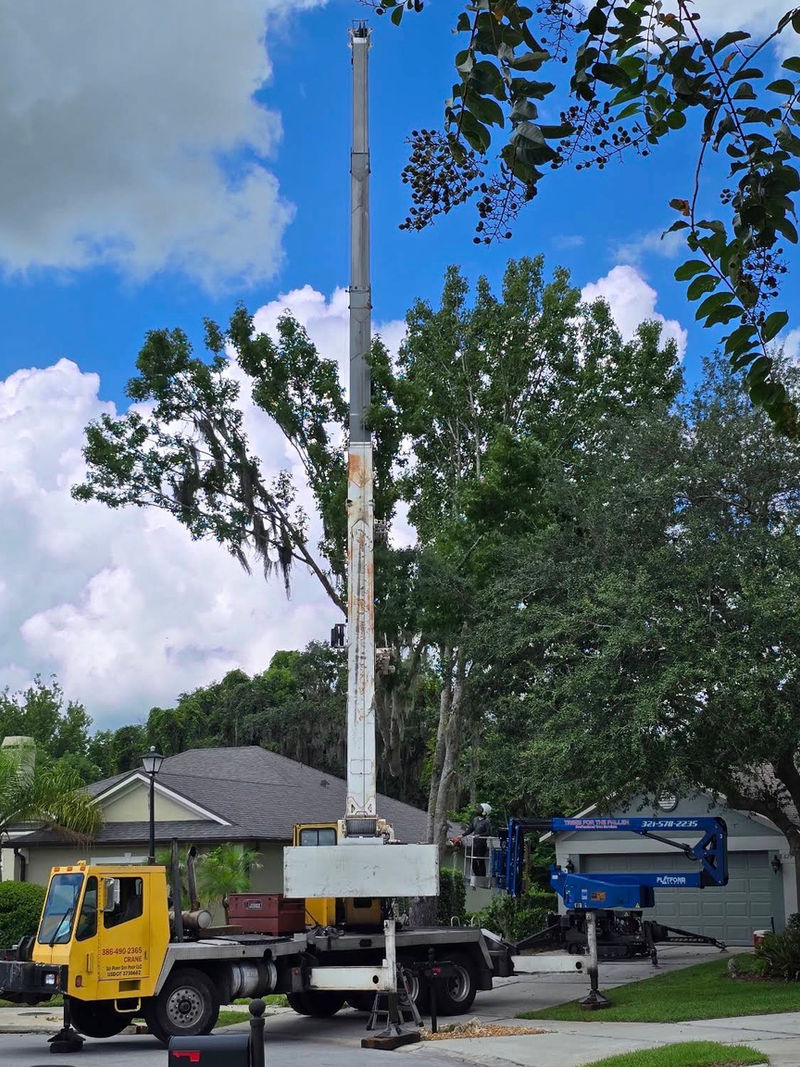
A clearance prune or a reduction on a sound oak is usually less than a removal. Most removals with more than one main limb run $900 to $2,500 when we can work from the yard or the driveway. A crane day over a roof is the job that reaches $4,500 to $5,500. Very few go past that. If the photos show a reduction, you should not be quoted a crane day.
The shop is in Osteen. A tree already on a house is a same-day call when a crew is free. A planned reduction is usually the same week.
What to send before we drive
One photo of the whole tree from the street.
One photo of the limb on the roof, the porch, or the cage.
One photo of the base of the trunk.
A note about access: driveway, side gate width, fence, or street only.
The HOA letter, if that is why you are calling.
Call (321) 578-2235 or use the quote form. The city pages for Sanford, DeLand, Longwood, Lake Mary, and Casselberry have the neighborhood detail. The rest of the map is on service areas.
Comments